
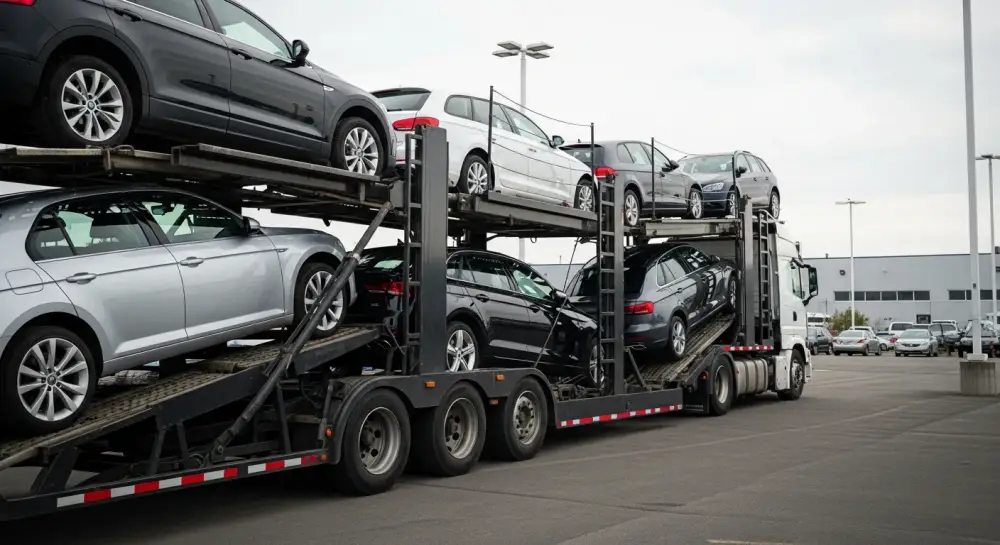
Dealership Auto Transport
Inventory moves for dealers, auction buyers and fleet accounts. Commercial orders only.
Quick answer
How does dealership auto transport work?
Dealership auto transport moves vehicle inventory for businesses: dealer trades between stores, units bought at dealer auctions, and fleet vehicles going between locations. HTS books a car hauler with active FMCSA authority, at least $1 million auto liability and $100,000 cargo coverage. Every order needs a company name and a unit count; we do not move personal vehicles.
Updated October 2026 by the HTS Logistics broker team (FMCSA MC# 1178470).
Who can book vehicle transport with HTS?
Dealerships, auction buyers buying for a business, and fleet operators. We broker the move under MC 1178470: HTS books the car hauler, and the hauler moves the units under its own authority, insurance and bill of lading.
Commercial orders only
Give us the company name and the number of units in the first request. We do not move a private owner's own car, and an order without a company name is declined.
How do dealer trades and dealer-to-dealer moves work?
A dealer trade is a two-point move with two dealerships on the paperwork, so each store needs a named person who can release or accept the unit. Send:
- Both stores' addresses, receiving hours and a contact at each one
- VIN, year, make and model of every unit, and which direction each one goes
- Whether each unit runs, steers and brakes, and where the keys will be
- Height and length of any tall or long unit: high-roof vans, dually and lifted pickups
- The date each unit has to be on the other lot
If the trade is a swap, list both directions: each direction is its own leg, and the unit coming back may ride a different truck. Tall units matter because the height limit applies to the loaded rig: in a 13 ft 6 in state, a high-roof van rides only where the deck leaves room for it, so its height has to be on the order before the hauler plans the load.
A car carrier bound for a store in New York City stays on NYC DOT truck routes until the cross street closest to the store (34 RCNY 4-13), so send the store's cross streets; our New York City truck route guide shows the network. On Long Island, trucks are barred from the parkways, and the Long Island truck routes page shows the roads they can use.
How does an auction pickup work?
Car auction transport runs on the auction's own release rules. Four things decide whether the unit leaves the lot on the first visit:
- 1
Pickup details
The auction's address and pickup hours, the lot or stock number, the VIN, and the buyer name on the purchase.
- 2
Release
If the auction issues a gate pass or release number, send it with the order. Without it the driver may not be allowed to load.
- 3
Storage date
If the auction starts charging storage after a set number of days, tell us that date so the pickup is booked ahead of it.
- 4
Condition at the lot
The driver checks the unit against the paperwork and records its condition before loading, which is the baseline for any later claim.
Bought a machine rather than a car? Excavators, loaders and trucks from Ritchie Bros and IronPlanet auctions move as equipment loads; see auction equipment pickup.
What does a fleet vehicle move need?
A fleet move is several pickups, deliveries or both under one order, so the unit list drives the plan. Send it as a spreadsheet with:
- A unit list with VIN, year, make, model and body type for each vehicle
- Pickup sites with their hours and a contact at each
- Delivery addresses and the date units must arrive by
- Which units do not run, and which are box trucks, bucket trucks or other vehicles a car carrier cannot take
Every stop eats into the driver's day: hours-of-service rules count loading, unloading and signing receipts as on-duty time inside the 14-hour window (49 CFR 395.2, 395.3), so a route with many stops is planned around them. Vehicles a car carrier cannot take, such as box trucks and bucket trucks, go on heavy haul trailers as equipment loads.
Which rules apply to the car hauler?
Federal rules decide who may haul your units for hire, how long the rig can be and how long the driver can drive. Before you release a vehicle to any hauler, its USDOT number on FMCSA's SAFER snapshot should show active authority for property.
| Rule | What it says | Source |
|---|---|---|
| Registration | A for-hire car hauler working across state lines needs a USDOT number and FMCSA operating authority before it hauls. | 49 CFR 385.301 |
| Commercial vehicle | A pickup towing a car trailer is a commercial motor vehicle once the truck and trailer are rated or weigh 10,001 lb or more together. | 49 CFR 390.5 |
| Driver's license | A Class A CDL is required once the combination is rated at 26,001 lb or more and the trailer is rated over 10,000 lb. | 49 CFR 383.91(a)(1) |
| Insurance | Federal rules set $750,000 as the minimum for for-hire general freight; HTS books car haulers with at least $1 million auto liability and $100,000 cargo. | 49 CFR 387.9 |
| Length | No state may hold a stinger-steered car carrier to less than 80 ft, with front overhang under 4 ft and rear overhang under 6 ft. Cars may ride behind the cab and on an over-cab rack. | 49 U.S.C. 31111(b)(1)(G); 23 CFR 658.13(e) |
| Driving time | A driver may drive 11 hours inside a 14-hour window after 10 hours off duty, and loading, unloading and signing receipts all count as on-duty time. | 49 CFR 395.3; 395.2 |
| Liability | The carrier is liable for actual loss or damage to the vehicles it receives under its bill of lading, and no carrier may give you less than 9 months to file a claim. | 49 U.S.C. 14706 |
How tall can a loaded car carrier be?
There is no federal height limit; each state sets one, and two of the states we track give car carriers an extra 6 in.
| State | Legal height | Rule |
|---|---|---|
| New York | 13 ft 6 in | VTL 385(2) |
| New Jersey | 13 ft 6 in | N.J.S.A. 39:3-84 |
| Pennsylvania | 13 ft 6 in, including load | 75 Pa.C.S. 4922 |
| Connecticut | 13 ft 6 in | CGS 14-264 |
| Massachusetts | 13 ft 6 in, including load | MGL c.90 s.19 |
| Ohio | 13 ft 6 in, with or without load | ORC 5577.05 |
| Illinois | 13 ft 6 in | 625 ILCS 5/15-103 |
| Florida | 14 ft for an automobile transporter, including load (13 ft 6 in for other vehicles) | F.S. 316.515(2) |
| Georgia | 14 ft for auto carriers on Interstates; 13 ft 6 in elsewhere | O.C.G.A. 32-6-22 |
| California | 14 ft for all vehicles | CVC 35250 |
| Texas | 14 ft for all vehicles | Tex. Transp. Code 621.207 |
Checked against each state's statute in October 2026.
What should you check at pickup and delivery?
The condition of every unit, in writing, at both ends. Under federal law a shipper's damage case against a carrier starts with three facts: the vehicle was handed over in good condition, it arrived damaged, and the amount of the loss. The carrier then has to prove it was not negligent and that an excepted cause did the damage (Missouri Pacific R. Co. v. Elmore & Stahl, 377 U.S. 134, 1964). The pickup condition report covers the first fact; the signed delivery receipt covers the second.
- At pickup, walk each unit with the driver and have existing scratches, dents and chips marked on the condition report.
- At delivery, inspect before you sign, with the driver still there.
- Write any new damage on the delivery receipt by panel, and photograph it.
- Send the carrier a written claim with the amount; a note on the receipt alone is not a claim (49 CFR 370.3).
How the carrier must answer, and in how many days, is in our questions about damage claims and documents.
Get a dealer, auction or fleet quote
Start with the company name, the unit count and the origin and destination ZIP codes. We follow up for the VINs, the release paperwork and the dates, then book a hauler whose authority and insurance meet the minimums above.
Prefer to talk? Call (631) 683-8275, Monday to Saturday, 24 hours. Car haulers looking for loads can apply through carrier setup.
Get Fleet Quote
Dealer, auction and fleet transport questions
How much does it cost to transport a car from one dealership to another?
We quote each order instead of publishing a per-car rate, because the price turns on the distance, how many units share the trailer, whether each unit runs, and whether a car carrier, up to 80 ft long under federal rules, can get into both lots. Send both addresses, the VINs and the date the units must arrive for a quote.
How do you transport a car from an auction?
Book it with the auction's address and pickup hours, the lot or stock number and VIN, and the gate pass or release if the auction issues one. The carrier's driver matches the unit to the paperwork, records its condition on the lot and loads it. If storage charges start on a set day, give us that date and the pickup is planned before it.
Do you move personal vehicles?
No. Vehicle orders come only from dealers, auction buyers and fleet accounts booking under a company name, with the number of units on the order. We decline a private owner's own car, including a single car bought at a public auction for personal use. Equipment and commercial trucks for a business are a different matter: those move as equipment loads.
How many vehicles fit on one car carrier?
It depends on the vehicles and the trailer, so we do not promise a fixed number. The loaded rig has to stay within 80,000 lb gross on the Interstate, the height limit where it travels (13 ft 6 in in New York, for example) and the length rules for car carriers, and full-size pickups and vans take more of that room than sedans. Send the year, make and model of each unit.
What should I do if a vehicle arrives damaged?
Before the driver leaves, write the damaged panel and what you see on the delivery receipt, and take photos with the unit still beside the trailer. Check it against the condition recorded at pickup, because damage noted there is not transit damage. The claim itself goes to the carrier in writing, since it is liable for vehicles it received under its bill of lading (49 U.S.C. 14706).
Can you move fleet trucks that do not fit on a car carrier?
Yes, as an equipment move. Box trucks, bucket trucks and dump trucks go on a step deck, RGN or lowboy, and once a unit makes the load wider than 8 ft 6 in or the gross heavier than 80,000 lb, it needs permits like any oversize load. Send each truck's length, width, height and weight with the fleet list.
Sources
Facts on this page were checked in October 2026 against the sources below. Rules and rates change; we confirm current requirements on every move.
- 49 CFR 385.301: USDOT number and operating authority before interstate operations
- 49 CFR 390.5: definition of a commercial motor vehicle
- 49 CFR 383.91: commercial motor vehicle groups (Class A)
- 49 CFR 387.9: minimum levels of financial responsibility
- 49 CFR 395.2 and 395.3: on-duty time and driving limits
- 49 U.S.C. 31111: length limits, including automobile transporters
- 23 CFR 658.13(e): automobile transporters as specialized equipment
- 49 U.S.C. 14706: carrier liability under receipts and bills of lading
- 49 CFR 370.3: filing of loss and damage claims
- Missouri Pacific R. Co. v. Elmore & Stahl, 377 U.S. 134 (1964)
- NY VTL 385: dimensions and weights of vehicles
- N.J.S.A. 39:3-84 (NJDOT-hosted statute)
- 75 Pa.C.S. 4922: height of vehicles
- Connecticut General Statutes ch. 248 (14-264)
- MGL c.90 s.19: dimensions of vehicles
- ORC 5577.05: maximum size of vehicles
- 625 ILCS 5/15-103: height of vehicles
- F.S. 316.515: maximum width, height and length
- O.C.G.A. 32-6-22: height of vehicles (Justia reproduction)
- California Vehicle Code 35250: height
- Texas Transportation Code ch. 621 (621.207 height)
Keep reading
- Auction Equipment TransportRelease tickets, removal deadlines, storage fees and permit lead times for auction pickups, plus a pre-bid transport check.
- NYC Truck RoutesNew York City's truck route network, banned parkways and where bridge strikes happen.
- Carrier SetupRequirements and paperwork for carriers who want heavy haul and drayage loads from HTS.
- Heavy Haul TruckingOversize and overweight loads on RGN, lowboy, step deck and flatbed trailers across the 48 states.
- Heavy Equipment TransportTrailer choice, width-by-width permit and escort triggers and shipping ranges for 47 machines, plus six checks before you book a hauler.
- Heavy Haul TrailersSix trailer types from 83 manufacturer models: loaded deck heights, deck lengths, ratings and which machines each keeps under 13 ft 6 in.