
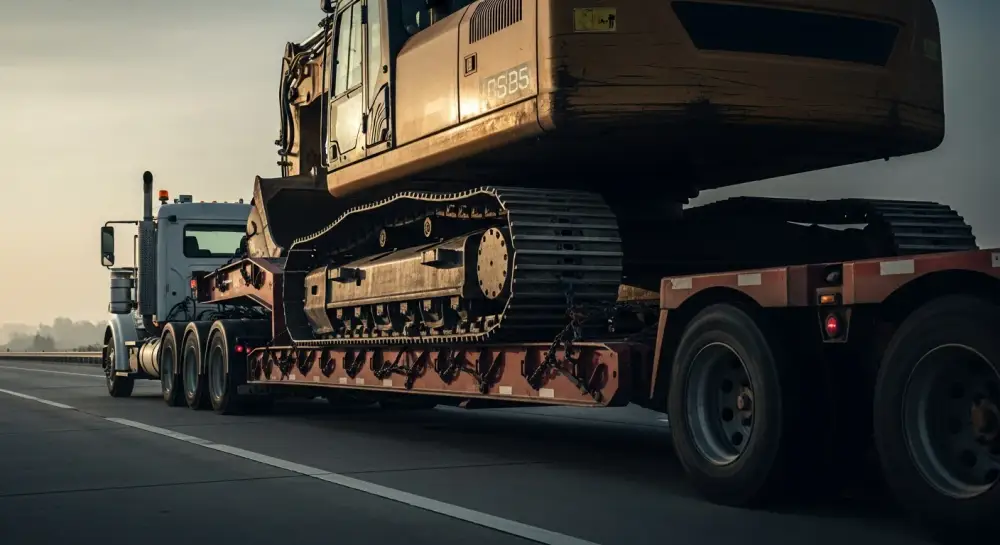
Florida Heavy Haul and Heavy Equipment Transport
Miami, Tampa, Orlando and Jacksonville, with the FDOT permit issued before the load reaches the state line
Quick answer
How far ahead should you book a heavy haul move into Florida?
As soon as the dimensions are final. Florida wants the FDOT permit issued before the truck enters the state and the route surveyed before the load rolls. Carriers can self-issue trip permits for loads within 16 ft of width, 18 ft of height and 150 ft of length, up to 200,000 lb; anything needing FDOT's structural review should go in 10 or more business days ahead.
Updated October 2026 by the HTS Logistics broker team (FMCSA MC# 1178470).
Who moves heavy equipment into and around Florida?
Florida heavy haul trucking has one rule that catches carriers from other states: the FDOT permit must be issued before the load crosses the state line (F.S. 316.550(1)). Escorts need a Florida qualification, or one earned in the last 4 years in a state whose standards are equal or tougher, and the truck and every escort must pull into each open weigh station, transponder or not.
Florida-based supply is thinner than the state's size suggests. FMCSA's census lists 3,066 Florida carriers with for-hire interstate operations that include machinery among their cargo, seventh among the states, or 11.1% of the 27,551 for-hire interstate carriers based in Florida; the national share is 16.6%. Brokers are plentiful by contrast: 2,069 active broker authorities on May 14, 2026, third behind Texas and California. Carriers report their own cargo types, so treat the count as a ceiling (data pulled October 17, 2026).
We book the carrier, whatever its home state, under our FMCSA broker license (MC 1178470) from East Northport, New York, and the carrier or its permit service applies in PAS, FDOT's Permit Application System. FDOT permits cover state roads only, so county and city roads at either end need local permits, which are planned before the quote.
What changes in Miami, Tampa, Orlando and Jacksonville?
Mostly the clock. FDOT's 2026 movement conditions keep wide loads (over 12 ft) and long ones (over 85 ft) parked during the weekday peaks (7–9 AM and 4–6 PM) across seven counties, interstates included, and some cities and corridors add their own rules (FDOT Blanket Permit Movement Conditions, revised July 27, 2026).
| Metro | Corridors | Local rules |
|---|---|---|
| Miami, Fort Lauderdale and West Palm Beach | I-95, I-75, Florida's Turnpike | Peak-hour curfew in Miami-Dade, Broward and Palm Beach counties. The Turnpike takes over-dimension loads only under an FDOT permit or a Turnpike Tandem Permit, with a 50 mph minimum speed. The Keys have their own night-only rule (see the FAQ). |
| Tampa and St. Petersburg | I-4, I-75, I-275 | Peak-hour curfew in Hillsborough and Pinellas counties. Lakeland and Sarasota apply it on state roads but not on interstates. |
| Orlando and the Space Coast | I-4, I-95, Florida's Turnpike | Peak-hour curfew in Orange County; Melbourne and Palm Bay apply it on state roads. Near Kennedy Space Center, anything over 10 ft wide is barred 6–9 AM and 3–6 PM from Monday to Friday, and the move is cleared with the KSC Duty Office. |
| Jacksonville | I-95, I-10, I-295 | Peak-hour curfew in Duval County. Port pickups are covered in the next section. |
| Tallahassee and Pensacola | I-10 | Both cities apply the curfew on state roads but not on interstates. With a law enforcement escort, a load from Alabama may enter on I-10 at night, up to the eastbound weigh station at Pensacola. |
In Florida's cities, 12 ft is the width to watch. A Cat 336 excavator (11 ft 9 in wide) needs no escort and is outside the seven-county curfew, though like any over-width load it moves in daytime only; a blade-off Cat D10, 12 ft 4 in wide, needs one escort and has to wait out the peak hours. Over 12 ft wide, two escorts replace one on roads with lanes under 12 ft, on bridges under 30 ft curb to curb and in urbanized areas carrying more than 8,000 vehicles a day per lane, unless the load shows four warning lights. Excavator sizes are on our excavator transport page.
Where does imported machinery come into Florida?
Mainly through Jacksonville, and on a smaller scale than Georgia's ports. In 2025 the Port of Jacksonville ranked 13th in the U.S. for imported dozers, excavators and loaders ($112.1 million) and 7th for off-highway dump trucks ($49.1 million), and 75.8% and 99.9% of that vessel value came off outside containers, so these are Ro-Ro or breakbulk pickups. The Tampa customs district, which includes Jacksonville, took $342.1 million of heavy equipment in all, 1.0% of U.S. imports, and the Miami district took $43.6 million of cranes (Census Bureau port data, pulled October 17, 2026).
Census records the port where cargo comes off the ship, not its destination, and a machine bound for Florida can just as well land at Brunswick or Savannah in Georgia. Then the trip is a two-state permit job, and the Florida permit has to be issued before the truck reaches the line. The release steps for a Ro-Ro or breakbulk machine are on our imported machinery pickup page.
How does Florida treat mobile cranes and removed attachments?
More generously than other oversize loads. Florida lets a permitted mobile crane and its support vehicles travel at any hour except under local curfews, provided the crane measures 12 ft or less across, 14 ft 6 in or less in height and 100 ft or less in length (F.S. 316.550(3)(b)). A Liebherr LTM 1100-5.2 all-terrain crane, which drives on its own axles and measures 9 ft across, 13 ft 1 in tall and 44 ft 9 in long, fits inside that envelope. Crane weights and component loads are on our crane transport page.
Removed attachments can ride along. On an overweight permit, Florida allows up to two removed attachments on the same load (F.A.C. 14-26.012(10)), so a Cat D8 can travel 9 ft 2 in wide with its blade and push arms off instead of 13 ft 3 in with the blade on, and carry both pieces on the trailer if the weights work.
Measure the machine as it will ship, because Florida fines the difference. Overweight is $0.05 per lb over the permitted weight, over-dimension is up to $1,000 per vehicle ($250 per foot of height or width), and running off-route or at night without authorization voids the permit (F.S. 316.550(10)).
FDOT permit basics
- Without a permit, loads may be 13 ft 6 in tall (14 ft for auto transporters) and 8 ft 6 in wide.
- One qualified escort starts over 12 ft wide: in front on two-lane highways, behind on four-lane divided highways.
- Permits come from the FDOT State Permit Office through PAS.
- Oversize trip permits cost $5, $15 or $25 by size; overweight is charged per mile by gross weight.
The Florida oversize permit rules page has the full escort tiers, the 2026 holiday dates and the route survey details.
Before a load heads into Florida
Do you handle pickups at the Port of Jacksonville?
Yes. When the release from customs and the ocean line is in hand, we need the terminal, the bill of lading and the machine details. Jacksonville's machinery imports come off mostly as Ro-Ro or breakbulk, so the carrier loads at the terminal onto an RGN or lowboy, and a load over 12 ft wide leaving through Duval County stays parked through the weekday peaks, 7–9 AM and 4–6 PM.
Can you move equipment to the Florida Keys?
Yes, on tighter hours. South of Florida City, a load over 10 ft wide on a blanket permit may run only from 9 PM to 5 AM, never on holidays, at no more than 12 ft wide and with at least one qualified escort (FDOT blanket conditions, July 2026). A wider machine needs a trip permit with its own conditions, so send the Keys address before the move is scheduled.
Can you collect equipment from a Florida auction or rental yard?
Yes. Ritchie Bros and IronPlanet purchases and Cat Rental machines are among the loads we arrange. Give us the auction lot or rental contract, where the machine sits and when the yard loads trucks, plus the model. If the yard is in one of the seven curfew counties and the load is over 12 ft wide, the pickup is timed to avoid the weekday peaks (7–9 AM, 4–6 PM).
Are Florida permit fees waived after a hurricane?
For some loads. FDOT exempts loads moved under a Governor's Declaration of Emergency from permit fees, and it issues temporary Emergency Road Use Permit Letters during declared emergencies; Letter 26-07, issued October 8, 2026 for Tropical Storm Isaias, covered divisible emergency and agricultural loads. Oversize-only farm and forestry equipment is fee-exempt all year. A machine moved for ordinary work pays the normal fee.
What details does a Florida quote need?
The machine's model or its measured size and weight, both addresses with their counties, your dates, and where the trip starts. Say which attachments come off: on an overweight permit, Florida lets up to two of them ride on the same trailer. If the load starts in another state, the FDOT permit must exist before the truck reaches the line, so final dimensions are needed early.
Sources
Facts on this page were checked in October 2026 against the sources below. Rules and rates change; we confirm current requirements on every move.
- FMCSA Company Census File (data.transportation.gov, az4n-8mr2) (pulled Oct 17, 2026; cargo types such as Machinery, Large Objects are self-reported on Form MCS-150)
- FMCSA Carrier - All With History, legacy Licensing and Insurance file (6eyk-hxee) (active broker authority counts as of May 14, 2026, when the file was frozen)
- U.S. Census Bureau: Port Imports HS6 (December 2025 and August 2026 files) (general imports by port of unlading, customs value; pulled Oct 17, 2026; 2026 figures preliminary)
- FDOT: Over-weight over-dimension permits (State Permit Office, PAS)
- F.A.C. 14-26.008: Schedule of fees and exemptions (FDOT PDF, 4-24-2018)
- F.A.C. 14-26.012: Movement conditions and restrictions
- F.A.C. 14-26.00411: Procedure for issuance of permits
- F.A.C. 14-26.00425: Criteria for issuance of permits (overrides)
- FDOT Blanket Permit Movement Conditions (rev. 7/27/2026)
- F.S. 316.550: Special permits (2026)
- F.A.C. 14-61.0015: Prohibitions on the Turnpike System
- FDOT Emergency Road Use Permit Letter 26-07 (Oct 8, 2026)
- Liebherr LTM 1100-5.2 technical data (hosted by Nordic Crane)
- Caterpillar 336 hydraulic excavator technical specifications (AEXQ4077-01 (12-2025))
- Caterpillar D8 track-type tractor technical specifications (AEXQ3723 (05-2024))
- Caterpillar D10 dozer technical specifications (AEXQ3209-03 (09-2026))
Request a Florida heavy haul rate
Tell us what is moving, between which two addresses and when. We plan the FDOT permit and any curfew county before we quote.
- FMCSA-licensed property broker, MC# 1178470
- Permits, escorts and route surveys arranged for each move
- Carriers checked for authority, insurance and safety record
- Commercial shippers, dealers, contractors and auction buyers
Prefer to talk? Call (631) 683-8275.
Request a Commercial Quote
Keep reading
- Crane TransportRough terrain cranes on a lowboy, all terrain cranes on their own axles and crawlers in nine loads, with OEM weights and permit triggers.
- Heavy Equipment Transport CostHow the price is built: per-mile benchmarks, permits, escorts and crossings, with worked examples.
- Florida Oversize PermitsFDOT limits, fees, escort qualification and holiday travel rules.
- Heavy Haul TruckingOversize and overweight loads on RGN, lowboy, step deck and flatbed trailers across the 48 states.
- Heavy Haul in New YorkLong Island, NYC and upstate moves, carrier counts by county, and machinery entering at Buffalo, Champlain, Albany and Port Newark.
- Heavy Haul in TexasHouston, Dallas-Fort Worth, San Antonio and Permian moves: inner-loop limits, Galveston, Freeport and Laredo pickups, and a worked TxDMV fee example.