
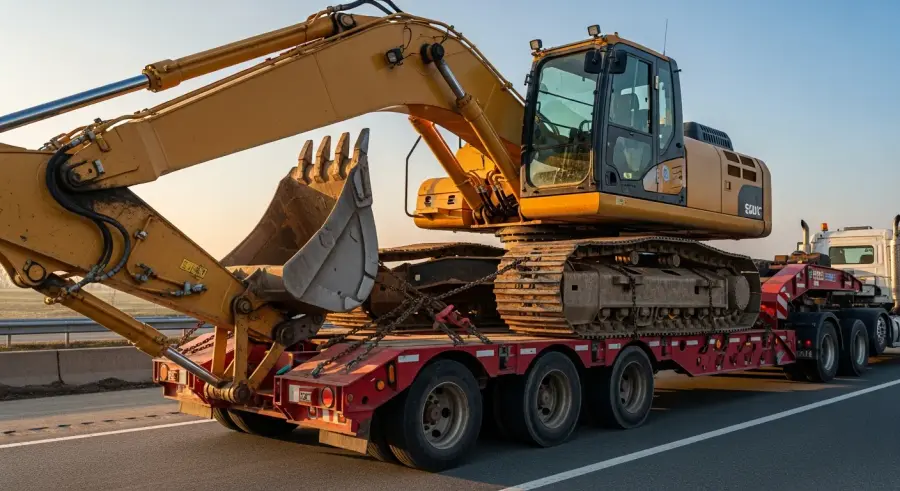
Excavator Transport & Hauling
From the 12,688 lb Cat 305 CR to the 207,400 lb Cat 395: trailers, permits and what comes off
Quick answer
What is the best way to transport an excavator?
Match the trailer to the size class. Mini excavators like the Cat 305 CR and 308 CR ride a flatbed or step deck with no permits. From the 20-ton class up, the tracks are wider than 8 ft 6 in and the weight passes 45,000 lb, so the machine rides an RGN or lowboy under width and weight permits. The largest machines leave the counterweight to a second truck.
Updated November 2026 by the HTS Logistics broker team (FMCSA MC# 1178470).
Of all the machine types in our heavy equipment transport data, excavators span the widest weight range: from a 12,688 lb Cat 305 CR that fits a flatbed with room to spare to a 207,400 lb Cat 395 that is taken apart before it goes anywhere.
For each one the move turns on three numbers: track width on the shoes it was ordered with, height with the boom lowered and the stick folded, and weight with or without the counterweight. HTS Logistics, a licensed property broker, checks those against the manufacturer's documents and your unit, then books a carrier whose trailer fits. The figures below come from Caterpillar, Komatsu, John Deere and Volvo, checked in October 2026.
Mini excavator transport: what size truck and trailer?
Cat lists the 305 CR at 12,688 lb and the 308 CR at 20,771 lb, both without a bucket, at 6 ft 6 in and 7 ft 7 in wide and 8 ft 4 in tall in shipping position. Both are legal-size loads for a flatbed or step deck, on width, height and weight alike. They clear 13 ft 6 in even on a standard flatbed: Utility lists its 48 ft 4000S at 58 3/16 in high, which leaves just under 8 ft 8 in of load height.
If you plan to tow one yourself, size the rig from the weights. Any trailer rated to carry a 305 CR is rated over 10,000 lb, so once the truck and trailer ratings add up to 26,001 lb or more, the rig is a Group A combination under 49 CFR 383.91, the class that takes a Class A commercial driver's license in commercial use. For a commercial move we book a carrier running a flatbed or step deck behind a semi tractor, which carries either mini at legal size.
Two cautions. Cat's mini weights leave out the bucket, so add it and any thumb, coupler or hammer. And the 308 CR's 8 ft 4 in shipping height assumes the long stick is pinned in transport position with nothing on it. With a bucket on and the stick in working position its boom stands 10 ft 0 in, close to 14 ft 10 in on that flatbed, so it goes on a step deck instead, where a 34 to 40 in lower deck keeps it at about 12 ft 10 in to 13 ft 4 in.
A Cat 299D3 or Bobcat T770 track loader headed to the same job is a legal-size load too, at 11,464 lb and 10,515 lb; our construction equipment transport page covers when two machines can share a trailer.
How to load a digger onto a trailer
The carrier's driver loads and secures the machine. These are the steps, and what each one changes on the permit:
- 1
Put it in the maker's transport posture
Boom lowered, stick and bucket folded under, blade down. Cat quotes the 308 CR's 8 ft 4 in shipping height with the long stick pinned in transport position and no attachments.
- 2
Fold what sticks up or out
Volvo's EC230 guardrail stands 10 ft 3 in when raised, above its 9 ft 11 in boom, so it folds for the trip. On a Cat 395 the walkways make the upper frame 14 ft 10 in wide; Cat offers a tilt-up walkway option.
- 3
Track it on
An RGN's gooseneck comes off so the excavator can drive straight onto the deck from the front. A mini can climb the ramps or beavertail at the back of a step deck.
- 4
Lower everything and chain it
For machines of 10,000 lb or more, 49 CFR 393.130 calls for accessory equipment such as the bucket and boom to be fully lowered and secured, and for at least four tiedowns placed close to the front and rear or at the maker's tie-down points. That covers every excavator on this page, down to the 12,688 lb Cat 305 CR, whose track frames carry tie-down points as standard.
- 5
Measure before it leaves
Height from the road to the highest point and width at the widest point go on the permit. A load taller or wider than its permit is not covered by it.
Excavator shipping dimensions and weights, 11 machines
In transport posture (boom lowered, stick and bucket folded) as each maker publishes it, lightest first. None of the four makers publishes a shipping weight for these excavators, so the weight is operating weight with the bucket on unless noted. Loaded heights add a deck about 2 ft high, our planning figure.
| Excavator | Shipping size (L x W x H) | Loaded height (est.) | Weight | Permits needed |
|---|---|---|---|---|
| Cat 305 CR stands in for the 305.5, no longer sold in the US | 17 ft 6 in x 6 ft 6 in x 8 ft 4 in | 10 ft 4 in | 12,688 lbno bucket | None |
| Cat 308 CR long stick, steel tracks with pads | 22 ft 7 in x 7 ft 7 in x 8 ft 4 in | 10 ft 4 in | 20,771 lbno bucket | None |
| Cat 320 790 mm shoes, HD bucket | 31 ft 3 in x 10 ft 5 in x 10 ft 4 in | 12 ft 4 in | 49,800 lb | Width and weight |
| Volvo EC230 600 mm shoes; closest current model to the EC220E | 31 ft 10 in x 9 ft 10 in x 9 ft 11 in | 12 ft 0 in | 51,588 lb | Width and weight |
| Komatsu PC220LC-12 800 mm shoes; replaced the PC210LC-11 | 31 ft 9 in x 10 ft 5 in x 10 ft 0 in | 12 ft 0 in | 54,013 lb | Width and weight |
| Komatsu PC360LC-11 850 mm shoes, 10 ft 5 in arm | 36 ft 7 in x 11 ft 3 in x 10 ft 9 in | 12 ft 9 in | 80,488 lb | Width and weight |
| Deere 350 P-Tier 800 mm shoes, 13 ft 1 in arm | 37 ft 0 in x 11 ft 1 in x 11 ft 10 in | 13 ft 10 in | 80,985 lb | Width, height and weight |
| Cat 336 850 mm shoes, 12 ft 10 in stick | 36 ft 8 in x 11 ft 9 in x 12 ft 0 in | 14 ft 0 in | 81,100 lb | Width, height and weight |
| Cat 349 no longer current in the US; fits units in service | 39 ft 1 in x 11 ft 7 in x 12 ft 1 in | 14 ft 1 in | 105,200 lb | Width, height and weight |
| Komatsu PC490LC-11 fixed gauge, 900 mm shoes | 39 ft 2 in x 11 ft 11 in x 11 ft 11 in | 13 ft 11 in | 107,850 lb | Width, height and weight |
| Cat 395 fully assembled; not a road-transport configuration | 49 ft 6 in x 12 ft 9 in x 17 ft 8 in | not hauled assembled | 207,400 lb | Width, height and weight; travels disassembled |
The Cat 395 row is Cat's machine fully assembled, which is not how it travels on US roads: at 207,400 lb and about 19 ft 8 in on a trailer it would be past New York's 200,000 lb and 16 ft superload lines before the truck was counted. It moves stripped, with the counterweight, front linkage and bucket on other trucks (see the weight section below).
Why 20-ton and larger excavators need width permits
From the 20-ton class up, the undercarriage alone is wider than 8 ft 6 in, and the shoe width ordered for ground conditions pushes it further. The same model can be a different load depending on how it was ordered:
| Model | Track shoe | Transport width |
|---|---|---|
| Volvo EC230 | 600 mm (24 in) | 9 ft 10 in |
| Volvo EC230 | 900 mm (36 in) | 10 ft 10 in |
| Cat 320 | 790 mm (31 in) | 10 ft 5 in |
| Komatsu PC220LC-12 | 800 mm (31.5 in) | 10 ft 5 in |
| Komatsu PC360LC-11 | 850 mm (33.5 in) | 11 ft 3 in |
| Cat 336 | 700 mm (28 in) | 11 ft 3 in |
| Cat 336 | 850 mm (33 in) | 11 ft 9 in |
| Komatsu PC490LC-11 | 900 mm (35.5 in), fixed gauge | 11 ft 11 in (brochure overall width: 12 ft 4 in) |
| Cat 395 | 900 mm (35 in), undercarriage retracted | 12 ft 9 in |
Up to 12 ft wide, an excavator needs a width permit in every state but no width escort in New York, New Jersey, Pennsylvania or Ohio, which covers every machine above through the Cat 336 at 11 ft 9 in. The Komatsu PC490LC-11 sits on the line: 11 ft 11 in on its fixed-gauge crawler but 12 ft 4 in by the brochure's overall width figure, most likely the optional variable-gauge frame. That difference crosses the 12 ft trigger for a NYS certified escort in New York, so if we cannot confirm the undercarriage, we plan for the wider number.
Toll roads can cut in lower. Through sunrise on January 2, 2027, construction limits the Ohio Turnpike to loads no wider than 10 ft and no taller than 13 ft 6 in, so even a 10 ft 5 in Cat 320 runs ODOT routes instead; our Ohio oversize permit guide has the state rules. For other routes, our oversize permit rules by state give each state's width, height and escort lines, and you can enter one excavator's loaded size in the oversize load checker to compare 48 states.
How tall is an excavator on a trailer? The stick decides
An excavator travels with its boom lowered and its stick and bucket folded under it. On most mid-size and large machines that folded front, not the cab, is the highest point, so stick (arm) length changes the transport height, sometimes enough to decide whether a height permit is needed. Loaded heights below are estimates on a deck about 2 ft high, against a 13 ft 6 in limit:
| Model and arm | Folded height | Loaded, 2 ft deck | Over 13 ft 6 in? |
|---|---|---|---|
| Komatsu PC360LC-11, 3,185 mm (10 ft 5 in) arm | 10 ft 9 in | about 12 ft 9 in | No |
| Komatsu PC360LC-11, 4,020 mm (13 ft 2 in) arm | 12 ft 4 in | about 14 ft 4 in | Yes |
| Deere 350 P-Tier, 3.2 m (10 ft 6 in) arm | 10 ft 9 in | about 12 ft 9 in | No |
| Deere 350 P-Tier, 4.0 m (13 ft 1 in) arm | 11 ft 10 in | about 13 ft 10 in | Yes |
| Cat 336, R3.2DB (10 ft 6 in) stick | 11 ft 5 in | about 13 ft 5 in | Borderline: about an inch under |
| Cat 336, R3.9DB (12 ft 10 in) stick | 12 ft 0 in | about 14 ft 0 in | Yes |
| Komatsu PC490LC-11, 3,380 mm (11 ft 1 in) arm | 11 ft 11 in | about 13 ft 11 in | Yes |
| Cat 395, GP boom, stick and bucket installed | 17 ft 8 in | about 19 ft 8 in | Yes; still about 15 ft 4 in with only the boom installed |
The deck can matter as much as the stick. A Cat 336 on its 12 ft 10 in stick stands 12 ft 0 in: about 14 ft 0 in on a 24 in deck, but about 13 ft 2 in on a 14 in low-profile RGN such as Trail King's TKHD-S, which keeps it under 13 ft 6 in.
Height brings escorts as well as permits. New York wants a front escort with a height pole once a load reaches 14 ft, so a Komatsu PC360LC-11 on its long arm (about 14 ft 4 in on a 2 ft deck) picks up an escort that the same machine on its short arm (about 12 ft 9 in) does not need. Pennsylvania's height-pole and route-survey rule starts over 14 ft 6 in, which only the Cat 395 reaches here. The New York oversize permit rules cover the rest.
What comes off a large excavator, and what it weighs
Every excavator from the 20-ton class up in our data weighs more than 45,000 lb, so on a standard tractor and trailer it moves as an overweight load. On the bigger machines the question is how much can come off, and the answer is mostly the counterweight, the bucket and the front linkage. These are the makers' own component weights:
| Model | Operating weight | Counterweight | Bucket | Other OEM component weights |
|---|---|---|---|---|
| Cat 320 | 49,800 lb | 9,300 lb | 2,100 lb (HD) | Reach boom 3,800 lb; stick 2,400 lb |
| Komatsu PC360LC-11 | 80,488 lb | 15,255 lb | 3,425 lb | Not published |
| Deere 350 P-Tier | 80,985 lb | 15,274 lb | 3,377 lb | Boom with arm cylinder 6,790 lb; 4.0 m arm 4,376 lb |
| Cat 336 | 81,100 lb | 14,990 lb | 3,850 lb | Reach boom 7,230 lb; stick 4,490 lb; 850 mm shoes 11,690 lb |
| Cat 349 | 105,200 lb | 19,842 lb (removal-type option 18,960 lb, North America only) | 5,190 lb | Reach boom 9,720 lb; stick 5,540 lb |
| Komatsu PC490LC-11 | 107,850 lb | 21,105 lb standard; 19,180 lb with the optional removal system | 4,117 lb | HD boom with arm cylinder 8,856 lb; arm 4,720 lb |
| Cat 395 | 207,400 lb | 34,190 lb, with removal device | 11,440 lb | Stick 11,100 lb; 900 mm shoes 24,740 lb |
Counterweight removal is a factory option on some machines, not a standard transport step. Komatsu offers a removal system on the PC490LC-11 (not on the PC490LCi-11), and Cat offers a removal-type counterweight for the 349 in North America and a counterweight with removal device on the 395. None of the four makers lists one for the 20 to 36-ton machines above.
On a Cat 395, taking off the counterweight, the stick (and usually the boom) and the bucket is typical practice for US road transport. Cat publishes no transport breakdown, so we build that load plan from the component weights, then price each truck on its own and arrange its permits.
Which trailer does an excavator need?
Weight sorts excavators between a standard deck and a lowboy, and height and disassembly decide the rest:
| Trailer | Machines in our data | Why |
|---|---|---|
| Flatbed or step deck | Cat 305 CR and 308 CR | Under 21,000 lb before the bucket, 8 ft 4 in tall and inside legal width |
| RGN or lowboy | Cat 320 and 336; Komatsu PC220LC-12 and PC360LC-11; Deere 350 P-Tier; Volvo EC230 | 49,800 to 81,100 lb and 9 ft 10 in to 11 ft 9 in wide; the low deck keeps most of them under 13 ft 6 in |
| Multi-axle lowboy, often partly disassembled | Cat 349 and 395; Komatsu PC490LC-11 | Over 100,000 lb assembled; the counterweight, and on the 395 the front linkage, can travel separately |
An RGN trailer carries most excavators from the Cat 320 up: its gooseneck comes off for a front drive-on, and the RGN models we checked publish loaded deck heights of 14 to 24 in. Excavators bought at Ritchie Bros or IronPlanet auctions follow the same plan, with the yard's release and loading hours added; see auction equipment transport.
How much does it cost to transport an excavator?
It follows the size class. Our cost guide prices a Cat 308 CR over 500 miles at about $1,655 to $1,805 on paper, from national flatbed averages for September and October 2026, because a legal-size mini needs no permits or escorts. A Cat 320 adds width and weight permits and an RGN rate, and a Cat 395 turns into several trucks, each priced and permitted on its own.
See the cost to ship an excavator worked out line by line, next to the permit fees and escort rates that apply once a machine is oversize. Those are figures for scale; a quote follows your lane, your dates and your machine.
What to have ready before you book excavator transport
The details that most often move an excavator off its brochure numbers:
- Make, model and serial number. Older or discontinued models (Komatsu PC210LC-11, Volvo EC220E, Cat 349, Cat 305.5) can differ from the current machine in their class.
- Track shoe width, and fixed or variable-gauge undercarriage.
- Boom and stick length, including any long-reach or demolition front.
- Bucket, thumb, coupler, hammer or other attachments, and whether they ship on the machine.
- Counterweight type and whether it is the removable kind.
- Pickup and delivery addresses, loading hours and site access, plus release paperwork for an auction or dealer pickup.
Excavator transport questions
Does a mini excavator need a permit to transport?
Usually not. Mini excavators in the 5 to 8-ton class, such as the Cat 305 CR and 308 CR, are under 8 ft 6 in wide, about 8 ft 4 in tall in shipping position, and light enough that the truck and trailer stay well under 80,000 lb gross. A permit comes into play only when something else on the trailer pushes the load past a width or weight limit, or when the machine rides high with its bucket on.
Do 20-ton excavators need oversize permits?
Yes, for width and weight. In our data the 20-ton class runs from 9 ft 10 in wide (Volvo EC230 on 600 mm shoes) to 10 ft 5 in (Cat 320 and Komatsu PC220LC-12) and weighs 49,800 to 54,013 lb, more than the roughly 45,000 lb a standard tractor and trailer can carry inside 80,000 lb gross. Height is usually fine at about 12 ft to 12 ft 4 in loaded on an RGN.
Should the bucket be removed before shipping an excavator?
Cat, Komatsu, Deere and Volvo do not require it, but it is common practice when weight or length is tight. Buckets on the 20 to 50-ton machines in our data weigh 2,100 lb (Cat 320 HD) to 5,190 lb (Cat 349), and the Cat 395's 5.2 cubic meter bucket weighs 11,440 lb. On Cat mini excavators the published weights already leave the bucket out.
Can you move an excavator that does not run?
Yes, but it cannot track onto the trailer, so it has to be lifted or winched on. We plan a crane, a large forklift or a winch-equipped trailer for each end and show it as its own line on the quote, since that equipment and its time are paid for apart from the haul. Tell us before pickup whether the machine starts, swings and steers.
Is an excavator equipment or a vehicle?
For road transport, a crawler excavator is cargo. It is not built for highway travel, so it rides a trailer, and the oversize permit is issued for the truck, the load and the route, with the excavator's dimensions written on it. Federal cargo rules treat it as heavy equipment on tracks, which is why its securement follows the machinery section of 49 CFR Part 393.
Sources
Facts on this page were checked in October 2026 against the sources below. Rules and rates change; we confirm current requirements on every move.
- Caterpillar 305 CR (Cat 305 CR Mini Excavator brochure (NACD) AEHQ8376-04 (10-2025), Build 07A (North America, Chile, Columbia))
- Caterpillar 308 CR (Cat 308 CR Mini Excavator brochure AEHQ8518-01 (10-2025), Build 08A)
- Caterpillar 320 (320 (07H) Hydraulic Excavator Technical Specifications (N Am) AEXQ3758-01 (11-2025))
- Caterpillar 336 (336 (08D) Hydraulic Excavator Technical Specifications (N Am) AEXQ4077-01 (12-2025))
- Caterpillar 349 (349 Hydraulic Excavator Technical Specifications (Aus-NZ, S Korea, N Am) AEXQ2492-01 (09-2020), Build 07C)
- Caterpillar 395 (395 (07H) Hydraulic Excavator Technical Specifications AEXQ4024-01 (02-2026))
- Komatsu PC220LC-12 (Komatsu PC220LC-12/PC220LCi-12 brochure, EN-PC220LC/LCi-12-BR01-1025-V2 (c)2025)
- Komatsu PC360LC-11 (Komatsu PC360LC-11/PC360LCi-11 full brochure, EN-PC360LC-LCi-11-FB01-1022-V1 (c)2022)
- Komatsu PC490LC-11 (Komatsu PC490LC-11/PC490LCi-11 full brochure, EN-PC490LC-LCi-11-FB01-0524-V2 (c)2022)
- John Deere 350 P-Tier (John Deere 350 P-Tier Excavator brochure/specs ME350PAU (25-01))
- Volvo EC230 (Volvo EC230 product guide (Tier 4f), Ref. No 20062838_E / English-22 / 2024.08)
- Caterpillar 299D3 (299D3 Compact Track Loader brochure/spec sheet, AEHQ8203-02 (01-2021))
- Bobcat T770 (2026 Bobcat Full-Line Equipment Specifications B-1000 (08/26))
- eCFR: 23 CFR Part 658, truck size and weight (658.15 width; 658.17 gross and axle weights)
- eCFR: 49 CFR 393.130, securing heavy vehicles, equipment and machinery
- eCFR: 49 CFR 383.91, commercial motor vehicle groups (Group A combination vehicles)
- NYSDOT: NYS Certified Escort Manual 2025
- NYSDOT: Superloads (Type 1S permits, bonds, police escorts)
- 67 Pa. Code 179.10: permit conditions and pilot cars
- Ohio Turnpike: 2026 Holiday and Construction Restrictions
- Utility Trailer flatbed specifications (4000S: 58 3/16 in on a 47 in fifth wheel)
- Trail King TK80ACS step deck (34, 38 and 40 in loaded deck heights)
- XL Specialized XL 80 SD step deck (39 1/2 in loaded main deck)
- Trail King TKHD-S one-pager (14 in loaded deck height), 2026
- Trail King TK70HDG hydraulic detachable gooseneck (24 in loaded deck height)
Get an excavator transport quote
Send the excavator's model and serial number, track shoe width, boom and stick, the attachments that stay on, and the pickup and delivery points. We check it against the manufacturer's figures before we book the carrier and arrange the permits.
- FMCSA-licensed property broker, MC# 1178470
- Permits, escorts and route surveys arranged for each move
- Carriers checked for authority, insurance and safety record
- Commercial shippers, dealers, contractors and auction buyers
Prefer to talk? Call (631) 683-8275.
Request a Commercial Quote
Keep reading
- RGN TrailerHow a removable gooseneck detaches and loads, with specs for 21 RGNs and low-profile decks.
- Heavy Equipment TransportTrailer choice, width-by-width permit and escort triggers and shipping ranges for 47 machines, plus six checks before you book a hauler.
- Bulldozer TransportBlade-off widths, shipping weights, loaded heights and escort triggers for 13 dozers, Deere 450 P-Tier to Cat D11.
- Crane TransportRough terrain cranes on a lowboy, all terrain cranes on their own axles and crawlers in nine loads, with OEM weights and permit triggers.
- Tractor TransportWhich trailer deck keeps a tractor at legal height, with John Deere 8R and 9RX sizes and state escort rules.
- Forklift TransportForklift and telehandler transport for 11 OEM models, from an 8,000 lb Toyota on a step deck to a 133,860 lb Hyster H1050XDS48 that needs width, height and weight permits.