
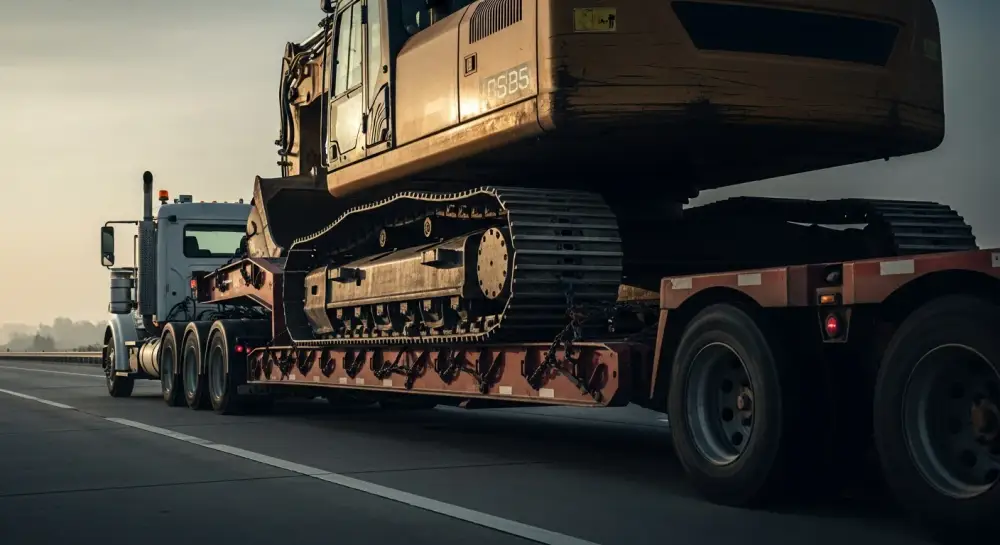
Heavy Haul Trucking and Oversize Load Transport
RGN, lowboy, step deck and multi-axle carriers booked by a licensed broker, with permits for every state on the route
Quick answer
What is heavy haul trucking?
Heavy haul trucking moves loads that are over the legal limits: wider than 8 ft 6 in, taller than the state's legal height (13 ft 6 in in most states, 14 ft or more in much of the West), or heavier than 80,000 lb gross or the axle limits. Each state on the route issues its own permit, the trailer must suit the load's height and weight, and some loads need escorts.
Updated October 2026 by the HTS Logistics broker team (FMCSA MC# 1178470).
HTS Logistics is a licensed property broker (MC# 1178470). We do not own trucks: for each load we book a carrier that has the right trailer and active authority, arrange the permits for every road owner on the route, and track the move to delivery. If you are comparing heavy haul trucking companies, the questions below are the ones that decide price and timing, whoever hauls the load.
What counts as an oversize or overweight load?
A load is oversize or overweight when any one figure, measured with the load on the trailer, passes the limit for the road it is on. Federal rules in 23 CFR 658 set the baseline for the Interstate and the National Network; each state sets the rest.
| Limit | Federal rule | How states differ |
|---|---|---|
| Width | 8 ft 6 in (102 in) on the National Network | Every state permits wider nondivisible loads; escorts start at 12 to 14 ft in the Northeast. |
| Height | No federal limit | 27 of the 48 states we track set 13 ft 6 in; the other 21 allow 14 ft or more, among them California, Texas, Washington and Colorado. |
| Length | States may not cap a semitrailer under 48 ft on the National Network; 53 ft is the common limit | Overall length limits and overhang rules are set state by state. |
| Gross weight | 80,000 lb on the Interstate | Heavier loads need an overweight permit and enough axles to spread the weight. |
| Axle weight | 20,000 lb single axle, 34,000 lb tandem, and the Bridge Formula for axle groups | Some state laws set higher axle limits; New York's are 22,400 lb single and 36,000 lb tandem. |
Permits are only issued for nondivisible loads: ones that would lose their use or value if split, or that would take more than 8 work hours to take apart (23 CFR 658.5). If taking off a blade or bucket would bring a machine within the limits, expect to take it off; New Jersey, for one, voids any permit for a load that could be divided to meet them (N.J.A.C. 13:18-1.9). To check one load against every state we track at once, use the oversize load checker; for axle spacing, the Bridge Formula calculator.
What do heavy haulers haul?
Mostly construction, mining and farm machines, cranes, and industrial project cargo. The manufacturer figures below show why so many of them cross at least one limit before they leave the yard.
Excavators
A Cat 320 is 10 ft 5 in wide and weighs 49,800 lb in operating trim. That is a width permit, and once it sits on a tractor and trailer the gross passes 80,000 lb.
Dozers
A Cat D8 is 9 ft 2 in wide with the blade off and weighs 76,126 lb. On an RGN deck it stands about 13 ft 7 in, just over the 13 ft 6 in limit in the Northeast.
Cranes
A Grove RT765E-2 rough terrain crane ships at 10 ft 11 in wide and 89,349 lb with its 14,365 lb counterweight pinned on.
Farm machinery
A John Deere S790 combine is 12 ft 11 in wide even with the header off, and the header travels on its own trailer.
Imported machinery and project cargo
Transformers, piling rigs and machines that arrive Ro-Ro or breakbulk. Newark ranked fourth in the U.S. for liquid-filled transformer imports in 2025.
Shipping sizes for 47 machines, with the permit check for each, are on the heavy equipment transport pages.
Superload trucking: where each state draws the line
There is no national definition of a superload. Each state decides when a load stops getting a routine permit and starts getting an engineering review, a route survey or a police escort, and the lines are far apart. A 135,000 lb load 15 ft wide is a superload in Ohio, Massachusetts, Illinois (on a tractor-semitrailer), South Carolina and Arizona, but a routine single-trip permit in New York, Pennsylvania, Connecticut, Georgia, Texas, Virginia, Michigan and Missouri.
| State | Superload (or equivalent) when | What changes | Rule |
|---|---|---|---|
| New York | Over 16 ft wide, 16 ft high, 160 ft long or 200,000 lb (Type 1S) | Police escort on top of certified escorts, booked 2+ business days ahead; same $40 permit fee but a bond is required | NYSDOT superloads |
| New Jersey | No separate class in N.J.A.C. 13:18; over 16 ft wide or 14 ft 6 in high needs a route survey | Route survey attached to the application; over 14 ft high, utilities and road owners must be notified or the permit is void | NJDOT SUPERLOAD bulletin; N.J.A.C. 13:18-1.12(d) |
| Pennsylvania | Over 201,000 lb, 160 ft long or 16 ft wide (no height trigger) | Preliminary application at least three weeks ahead, windshield route survey, police escort plus a certified escort; only the hauler may apply | 67 Pa. Code 179.1; 75 Pa.C.S. 3108 |
| Connecticut | Over 150 ft long, 16 ft wide, 16 ft high or 200,000 lb | Night moves only, State Police escorts, a Connecticut-based certified route survey, 5 business days' lead time | CTDOT OSOW FAQ |
| Massachusetts | Over 130,000 lb | Detailed engineering calculations; $300 single-trip permit | 700 CMR 8.05(4) |
| Ohio | Over 120,000 lb, 14 ft wide or 14 ft 6 in high, or axle groups over routine limits | ODOT runs the bridge analysis itself up to 250,000 lb; heavier loads take about 2 weeks at its Office of Structural Engineering, then 1 to 2 days to issue | ODOT Operational Guide, Sec. 2 |
| Illinois | Over IDOT's practical maximums, such as 120,000 lb on a 6-axle tractor-semitrailer or 100,000 lb on 5 axles | Pavement and bridge analysis at $40 an hour, plus $50 and 3.5 cents per ton-mile over legal | 92 Ill. Adm. Code 554.604-605, 554.910 |
| Georgia | Over 16 ft wide or high, or 150,001 to 180,000 lb; Superload Plus over 180,000 lb | Superload $125, approval up to 3 days; Superload Plus $500 with a full bridge analysis, up to 3 weeks | Ga. Comp. R. & Regs. 672-2-.01 |
| Florida | No superload term; 'non-routine' when a structural evaluation or override is needed | Request at least 10 business days ahead; survey letter over 18 ft high or 22 ft wide | F.A.C. 14-26.00411 |
| California | Variance permit over 15 ft wide, 17 ft high or 135 ft long, or above standard weight classes | Apply at least 30 days ahead to Caltrans' variance unit | Caltrans Transportation Permits Manual |
| Texas | Super Heavy permit over 254,300 lb, or 200,001 to 254,300 lb with less than 95 ft of axle spacing | Apply in TxPROS 3 to 4 weeks ahead; a TxDOT-certified engineering firm submits the bridge analysis | 43 TAC 219.12(b)(7) |
| Alabama | Over 16 ft wide, 16 ft high, 150 ft long or 300,000 lb | At least 2 trooper or police escorts booked through ALEA after ALDOT pre-approval; most move 9 PM to 6 AM, Sunday to Thursday | ALDOT superload requirements |
| Virginia | Beyond single-trip maximums: 15 ft wide, 15 ft high, 150 ft long or the permit axle limits | Apply at least 10 working days ahead for VDOT review; over 18 ft wide, 250,000 lb, 200 ft or 16 ft high may need a travel plan with local police escorts | 24VAC20-82-60, -70 |
| South Carolina | Over 130,000 lb (engineering tiers at 130,000, 200,000 and 300,000 lb) | $100 application fee, $100 to $350 engineering analysis and a $3 per 1,000 lb impact fee over 130,000 lb | SCDOT OSOW Guidelines |
| Kentucky | Not defined in 601 KAR 1:018 | Loads over 15 ft 6 in high need a route survey; a pending amendment filed Sept 15, 2026 would add a $500 superload bridge analysis charge | 601 KAR 1:018 |
| Michigan | Over 16 ft wide, 15 ft high or 150 ft long (no weight trigger) | Superload application in MiTRIP plus MDOT review; the route is surveyed with a height pole | MDOT Form 2465; T-2 |
| Indiana | Over 15 ft high, 17 ft wide, 110 ft long or 200,000 lb (Indiana's published documents differ slightly) | $40 base plus review, design, $1 per mile and $10 per bridge fees; State Police escorts at $43 an hour per trooper | DOR fee sheet (July 2026); M-204S |
| Minnesota | Route survey required over 16 ft high, 20 ft wide or 175 ft long | Processing runs from 5 business days to months; MnDOT offers preliminary feasibility reviews | MnDOT superload guide (May 2025) |
| Iowa | No numeric superload threshold in Iowa Code 321E or 761 IAC 511 | Routine permits average about 4 hours; superloads take longer, and State Patrol escorts need a week's notice | Iowa DOT |
| Missouri | Over 16 ft wide, 16 ft high, 150 ft long or 160,000 lb | Route survey completed within 14 days of the start date, possible $425 escrow and $2,000,000 insurance | 7 CSR 10-25.020(15) |
| Nebraska | Over 16 ft wide or 150 ft long | Pre-run route survey; superload fees of up to $250, $400 or $800 by weight under the 2026 law | Neb. Rev. Stat. 60-667.02, 60-6,298(7) |
| Oklahoma | Any overweight load above ODOT's OL-1 standard trucks | Structural analysis of each bridge on a route not studied before; Highway Patrol escort contracts take 5 to 7 working days | OAC 730:50-5-4(l) |
| Arkansas | 180,000 lb or more, over 16 ft 6 in wide, 100 ft long or 15 ft 6 in high | Superload surcharge (up to $500 by statute); loads over 20 ft wide move on Sundays only | A.C.A. 27-35-210; 27 CAR 111 |
| Louisiana | No statutory term; loads over 232,000 lb go to DOTD's super-load desk | Each Mississippi River structure adds a $1,275 evaluation fee over 254,000 lb; State Police escort over 16 ft wide or 125 ft long | Louisiana DOTD |
| New Mexico | Over 170,000 lb | Route engineering investigation of roads, bridges and culverts before the permit; 200,000 lb and up go to the NMDOT Bridge Section | NMDOT |
| Colorado | Chapter 6 Special: over 16 ft high, 17 ft wide or 200,000 lb; Super Load: 500,000 lb or more across two lanes | Chapter 6 Special $250 and 3 to 5 business days (2 to 3 weeks lately); Super Load $800; front and rear escorts at minimum | 2 CCR 601-4, Ch. 6 |
| Utah | Over 17 ft wide, 17 ft 6 in high or 300,000 lb | UDOT's superload team routes it on weekdays only, in up to 14 days, and denies it if no workable route exists | UDOT oversize provisions |
| Arizona | Class C: over any Class A limit (14 ft wide, 16 ft high, 120 ft long or 250,000 lb) | Single trip only; average issue time 48 hours; bridge analysis over 250,000 lb can take up to 2 weeks | A.A.C. R17-6-104, R17-6-211 |
| Washington | Over 200,000 lb, 16 ft wide or 16 ft high, or trailer plus load over 125 ft | Form 560-022 approval before the permit: 30 calendar days ahead over 200,000 lb, 7 days for dimension-only loads; over 300,000 lb a pavement analysis, and the applicant may share its cost | WAC 468-38-405; RCW 46.44.091 |
| Oregon | Over 16 ft wide on Interstates and multilane highways, 14 ft wide on two-lane highways, 17 ft high or 150 ft long | Issuance can take up to 10 days; drivers need 3 years of combination-vehicle experience; a route survey or a monitored move billed to the carrier may be required | ODOT Oregon Superloads |
| Idaho | No superload term; extra ITD approval over 16 ft wide on red and black routes, 18 ft on Interstates, 16 ft high, or 120 ft long (150 ft on the Interstate) | Up to 24 working hours for approval; bridge analysis up to 3 business days to 250,000 lb and 10 above; over 800,000 lb a third-party analysis paid by the applicant | IDAPA 39.03.01.305.11, .316 |
| Montana | Over 18 ft wide, 150 ft long or 17 ft high, or a weight that needs Bridge Bureau approval | Class 1 (to 34 ft wide, 24 ft high and 200 ft) decided within 2 working days, Class 2 within 5; may need a traffic control plan, route survey and utility letters; no separate superload fee found | ARM 18.8.509(11); MDT Superload Instructions |
| Nevada | Over 17 ft wide on two- or three-lane highways, 19 ft on four or more lanes, 18 ft high, 200 ft long or 500,000 lb | Apply online at least 10 business days ahead; valid five days for one trip; Nevada Highway Patrol escorts; fees from $25 plus coordination costs; route survey over 18 ft high | NDOT; NAC 484D.640, 484D.645 |
| Mississippi | Over 17 ft wide, 121 ft long or 15 ft 7 in high, or 189,999 lb or more (2026 Manual; the codified rule says 20 ft, 120 ft, 17 ft and 190,000 lb) | Route survey and traffic control plan with the application; written utility and railroad permission over 16 ft 7 in high; blue-light escorts from 15 ft 9 in high, 160 ft or 300,000 lb | MDOT Permit Manual (1/13/2026) |
| Tennessee | Over 165,000 lb, 16 ft wide or 15 ft 6 in high | Move proposal with route survey and traffic control plan; 10 business days for oversize superloads and 15 to 30 over 250,000 lb; bridge evaluation $100 to $300, actual cost over 500,000 lb | Tenn. Comp. R. & Regs. 1680-07-01-.12, -.02(3) |
| North Carolina | Conflicting lines: 132,000 lb or 15 ft wide (19A NCAC 02D .0601), over 132,000 lb or 17 ft wide (SL-6), over 16 ft (Handbook) | Written application with axle schematics at least 10 business days ahead; $100 engineering application fee plus $12 per dimension and $3 per 1,000 lb over 132,000 lb; no continuous travel | 19A NCAC 02D .0601(c); NCDOT SL-6 |
| West Virginia | Anything over a single-trip limit: 16 ft wide, 120,000 lb, 28,000 lb single axle or 45,000 lb tandem | No size or weight cap, but every load must pass a bridge analysis (48 hours or more); WVDOH may require bridge work at the applicant's cost, a bond or a traffic control plan; same $20 fee | WVDOH Permit Information sheet; 157CSR5 6.5 |
| Maryland | Excessive size 16 ft or more high or wide or 100 ft long; excessive weight over 60 tons (120,000 lb); massive weight over 250 tons | Apply 2 working days, 10 business days or 30 business days ahead; structural review over 150,000 lb at $8 per structure; superloads move 9 AM to 3:30 PM or 8 PM to 6 AM with police and private escorts | COMAR 11.04.01, 11.04.02.01-1, 11.04.03 |
| Wyoming | Class A: over 18 ft wide, 17 ft high, 120 ft long or 160,000 lb, or over 25,000 lb single, 55,000 lb tandem or 65,000 lb triple | Approved only by the Overweight Loads Office, weekdays 7:30 AM to 4:30 PM; 24 hours' notice over 18 ft wide or high; heavy loads pay WYDOT's analysis and escort-personnel costs first (80 tons in statute, 125 tons in the rule: the two conflict) | WYDOT Rules Ch. 5, Sec. 4, 6; W.S. 31-18-804(g) |
| North Dakota | No superload definition is published; NDHP tiers heavy loads at 150,000, 175,000 and 200,000 lb | Over 150,000 lb graduated fees ($30 to $70) and district engineer approval off pre-approved routes; over 200,000 lb a Heavy Load Permit with bridge and district engineer approval, $0.05 per ton-mile above 200,000 lb and a $25 engineering fee | NDHP Policy 9-6 and Annex E; NDAC 38-06-03 |
| South Dakota | No superload definition is published in statute or rule, and no superload fee | Every overweight permit needs SDDOT route approval; review usually takes up to two working days, longer over 200,000 lb, over 12 ft wide when overweight, or over 16 ft high | ARSD 70:03:01:17; SD Motor Carrier Handbook |
| Kansas | Over 150,000 lb gross, or an axle group over K.A.R. 36-1-37 limits; large structures over 16 ft 6 in wide or 18 ft high | $200 single-trip permit after a KDOT bridge analysis (the first permit on a new study 3 days ahead; one study covers up to ten later permits within 30 days); front and rear escorts | K.A.R. 36-1-35, 36-1-38; K.S.A. 8-1911 |
| Wisconsin | No superload definition is published; WisDOT adds steps over 16 ft wide and 150,000 lb | Over 16 ft wide: escorts, no Interstate without a permit condition and a $10 review per region; over 150,000 lb a bridge review at $10 per employee-hour; law enforcement escorts over 18 ft wide, 200 ft long or 350,000 lb | Trans 250.05, 254.12, 254.16; WisDOT escort chart |
| Delaware | 15 ft or more wide or high, 120 ft or more long, or over 120,000 lb | Route survey within 14 business days of the move; Delaware State Police escort and notice 48 hours ahead; $60 plus weight fees and DelDOT's costs; review about 5 to 14 business days | 2 DE Admin. Code 2405-5 |
| Rhode Island | No superload term; moves beyond the New England consortium limits are handled as extra-large, and 200,000 lb or more may need a third-party structural analysis | Apply at least 5 working days ahead for engineering route checks; route surveys at 14 ft high or more; RITBA bridges need their own permit | 290-RICR-40-00-1.3(C), 1.4.16; RIDOT OSOW FAQ |
| Vermont | Engineering inspection at 15 ft or more wide, over 100 ft long, over 14 ft high or 150,000 lb or more | Up to 10 working days; valid 6 months for the same or smaller loads on the approved route; fees from $800 under 150,000 lb to $10,000 over 250,000 lb | Vermont DMV CVO-110; 23 V.S.A. 1402(a) |
| New Hampshire | Supermove: more than 15 ft wide, 110 ft long, higher than 13 ft 6 in, or more than 149,999 lb | Engineering inspection report by a NH-licensed professional engineer at the applicant's cost; 150,000 to 300,000 lb reviewed by NHDOT Bridge Design, over 300,000 lb an independent engineering report; no annual permits | N.H. Admin. Rules Tra 304.12 |
| Maine | No superload term; 'extreme loads' above the review-free weights, such as 140,000 lb on a 6-axle tractor-semitrailer or 177,000 lb on 8 axles | MaineDOT or Maine Turnpike Authority engineering review of 2 to 5 business days; police escorts at 16 ft wide or 125 ft long | 29-250 C.M.R. ch. 157, Sec. 12(2) |
Checked against each state's rules in October 2026. The issued permit controls.
Permits people miss: toll roads and bridges
A state permit covers the state's own highways. Toll authorities and bridge commissions issue their own, and a load stopped on one of these roads without its permit is running unpermitted, whatever the state permit says.
New York State Thruway
Its own Special Hauling Permit (ordered in HOOCS) over 80,000 lb, 8 ft 6 in wide or 65 ft long. NYSDOT trip permits are not valid on it, and oversize loads may not travel it on weekends.
Thruway TAP-623
New Jersey Turnpike, Garden State Parkway, Atlantic City Expressway
Permitted by their own authorities. An NJDOT permit covers state routes only.
N.J.A.C. 13:18-1.9
Delaware River toll bridges (NJ-PA)
A bridge commission permit over 80,000 lb, 13 ft 6 in high, 8 ft 6 in wide or 75 ft long, 2 business days ahead. Milford-Montague, Portland-Columbia and New Hope-Lambertville take nothing over 80,000 lb.
DRJTBC
Pennsylvania Turnpike
Its own Special Hauling Permit; a PennDOT permit is not valid on it. Super loads need ten business days.
67 Pa. Code 179.10(5)(ii); PA Turnpike
Ohio Turnpike
Its own permit even when the ODOT permit routes onto it. No permits over 14 ft high.
Ohio Turnpike special hauling
Illinois Tollway
A separate Tollway permit, and the IDOT permit number is needed before applying. Over 12 ft wide or 120,000 lb counts as a Tollway superload.
Illinois Tollway OW/OD permits
In New York the list is longer: the NYS Bridge Authority, New York City DOT (one permit per leg) and county roads such as Suffolk's each issue their own. The details are in our New York oversize permit guide.
How to transport an oversized load
- 1
Measure the load as it will ship
Width, height and weight with the machine on the trailer, not the brochure's operating figures. Attachments that come off (blades, buckets, counterweights, headers) can take a load under a permit line or out of superload range.
- 2
Pick the trailer from height and weight
The deck height decides how tall the load can be before it passes the state's legal height, and the axle count decides how much it can weigh. Tall or tracked machines usually go on an RGN or lowboy; heavier loads add axles.
How RGN trailers load and carry - 3
Permit every road owner on the route
One permit per state, plus toll roads, bridge authorities, New York City and county roads where they apply. Each permit names the route, so the carrier cannot detour.
- 4
Book escorts where a state requires them
Width triggers differ: over 12 ft in New York, over 13 ft in Pennsylvania, over 14 ft in New Jersey and Texas. Height, length and overhang carry their own triggers.
Escort rules in our state permit guides - 5
Plan around travel windows
Most states allow oversize travel in daylight only and ban it on major holidays; New York also bans Sunday travel, and the Pennsylvania Turnpike sets its own holiday windows.
How much do heavy haulers charge?
Carriers price heavy haul by the mile, and the rate climbs with each limit the load crosses. For scale: the national flatbed spot average was $3.61 a mile including fuel in September 2026, and one dispatch company's 2026 guide puts RGN loads at $3.50 to $6.00 a mile when legal, $5 to $15 when oversize or overweight, and $10 to $20 or more for superloads.
Permits and escorts are added on top, and they vary as much as the superload lines do: New York charges a flat $40 for a single-trip permit, Pennsylvania $46 to $97 plus 4 cents per ton-mile when overweight. The heavy equipment transport cost guide breaks down each piece with dates and sources.
Heavy haul trucking by state
- Heavy Haul in New York →Long Island, NYC and upstate moves, carrier counts by county, and machinery entering at Buffalo, Champlain, Albany and Port Newark.
- Heavy Haul in Texas →Houston, Dallas-Fort Worth, San Antonio and Permian moves: inner-loop limits, Galveston, Freeport and Laredo pickups, and a worked TxDMV fee example.
- Heavy Haul in California →LA, Bay Area and Central Valley moves: 10 ft metro curfews, Bay Bridge hours, Long Beach and Hueneme pickups, and pilot cars by route color.
- Heavy Haul in Florida →Miami, Tampa, Orlando and Jacksonville moves: permits before the state line, the seven-county rush-hour stop, and Jacksonville port pickups.
- Heavy Haul in Georgia →Brunswick and Savannah pickups to Atlanta, with the I-285 delivery window and the flat $30 permit.
- Heavy Haul in Illinois →Chicago deliveries via the four Cook County corridors, Tollway and city permissions, and Peoria and downstate runs.
- Heavy Haul in Ohio →Columbus, Cleveland and Cincinnati moves around the 2026 Turnpike closure to wide loads, the 22-county curfew and superload rules.
Heavy haul trucking questions
What is the difference between an oversize and an overweight load?
Oversize means a dimension is over the legal limit: wider than 8 ft 6 in, taller than the state's legal height or longer than its length limit. Overweight means the gross is over 80,000 lb or an axle group is over its limit, such as 20,000 lb on a single axle or 34,000 lb on a tandem under federal rules. Many machines are both, and the permit covers each condition.
What is a superload?
A load large or heavy enough that the state reviews it individually, usually with a bridge analysis, a route survey or police escorts. Each state draws its own line: Ohio at 120,000 lb or 14 ft wide, Pennsylvania at 201,000 lb, 160 ft long or 16 ft wide, and Texas at 254,300 lb for its Super Heavy permit.
Do I need a pilot car for my load?
It depends on the state and the dimension. New York requires a certified escort over 12 ft wide, Pennsylvania a pilot car over 13 ft, and New Jersey and Texas an escort over 14 ft. Length, height and overhang add their own triggers, and some crossings, such as Port Authority bridges into New York City, require a police escort for any oversize load.
How far ahead does a superload have to be planned?
Weeks, not days. Pennsylvania wants the preliminary superload application at least three weeks ahead, Texas Super Heavy permits take 3 to 4 weeks with an engineer's bridge analysis, California variance permits 30 days, and Connecticut superloads 5 business days plus a route survey done within a week of the move. Routine permits are covered in our guide to how oversize permits work.
What is a nondivisible load?
Federal rules call a load nondivisible when splitting it would compromise its intended use, destroy its value, or take more than 8 work hours to dismantle with appropriate equipment (23 CFR 658.5). States issue oversize and overweight permits for nondivisible loads; a load that can be broken down into legal pieces has to be.
Can you pick up equipment bought at Ritchie Bros or IronPlanet auctions?
Yes. We move equipment bought at Ritchie Bros and IronPlanet auctions and rented through Cat Rental. Send the item or lot number, the yard address and its pickup hours, and the make and model, and we check the machine's shipping dimensions before booking the carrier.
Sources
Facts on this page were checked in October 2026 against the sources below. Rules and rates change; we confirm current requirements on every move.
- eCFR: 23 CFR Part 658, Truck Size and Weight (658.5 definitions, 658.17 weight)
- NYSDOT: Superloads
- NYS Thruway: TAP-623 Special Hauling Permit Program Guidelines
- NJDOT SUPERLOAD permit system and N.J.A.C. 13:18
- Delaware River Joint Toll Bridge Commission: truck permits
- PennDOT certified escort policy for superload moves
- Pennsylvania Turnpike: permits and restrictions
- CTDOT: oversize/overweight permit FAQ
- MassDOT: 700 CMR 8.00
- ODOT: Operational Guide for Special Hauling Permits
- Ohio Turnpike: special hauling permits
- 92 Ill. Adm. Code 554.605: superload moves
- Illinois Tollway: overweight/overdimension permits
- Ga. Comp. R. & Regs. 672-2-.01
- F.A.C. 14-26.00411: permit procedures (Florida)
- Caltrans: variance permits
- TxDMV: Superheavy single-trip permits
Get a heavy haul quote
Send the load's length, width, height and weight (or the make and model), the pickup and delivery points and your dates. We check the limits for every state on the route before we quote.
- FMCSA-licensed property broker, MC# 1178470
- Permits, escorts and route surveys arranged for each move
- Carriers checked for authority, insurance and safety record
- Commercial shippers, dealers, contractors and auction buyers
Prefer to talk? Call (631) 683-8275.
Request a Commercial Quote
Keep reading
- Heavy Equipment TransportTrailer choice, width-by-width permit and escort triggers and shipping ranges for 47 machines, plus six checks before you book a hauler.
- Oversize PermitsLegal limits, permit fees, escort triggers and travel rules by state, from official sources.
- Heavy Haul TrailersSix trailer types from 83 manufacturer models: loaded deck heights, deck lengths, ratings and which machines each keeps under 13 ft 6 in.
- Dealership Auto TransportVehicle inventory moves between dealerships, auctions and fleet accounts.
- Heavy Haul in New YorkLong Island, NYC and upstate moves, carrier counts by county, and machinery entering at Buffalo, Champlain, Albany and Port Newark.
- Heavy Haul in TexasHouston, Dallas-Fort Worth, San Antonio and Permian moves: inner-loop limits, Galveston, Freeport and Laredo pickups, and a worked TxDMV fee example.